A plain-language introduction to the singing, the hollow square, the four shapes, the fasola syllables, and what is happening when a room of people opens the book and starts singing.
01
How singing works
What Sacred Harp Is
Sacred Harp is a participatory American shape-note singing tradition. People gather to sing from The Sacred Harp, a tunebook of hymns, anthems, fuging tunes, and spiritual songs. It is not a concert format. The singers are the music.
Speaker noteFrame this as a participatory technology before it is a repertoire. CS Club may latch onto the protocol/social-system angle.
02
How singing works
Why It Sounds Different
Sacred Harp singing is loud, full-bodied, and direct. There are usually no instruments, no conductor, and no audience. The goal is not blended choral polish; it is shared singing with conviction.
03
How singing works
The Hollow Square
Singers sit in four sections facing inward.
The leader stands in the center and beats time.
Tenors, also called leads, carry the main melody.
Everyone sings toward everyone else, not toward a stage.
04
How singing works
Who The Sections Are
Treble sits together, usually on one side of the square.
Alto has its own section, with parts added to many older tunes.
Tenor, or lead, carries the melody and often anchors the room.
Bass sits opposite the trebles and gives the harmony its floor.
05
How notation works
The Four Shapes
Fa
major: 1 and 4
minor: 3 and 6
Sol
major: 2 and 5
minor: 4 and 7
La
major: 3 and 6
minor: 1 and 5
Mi
major: 7
minor: 2
06
How notation works
Why Shapes Help
The shape tells you the solfege syllable before you know the exact pitch. That means a singer can look at unfamiliar music and still have a foothold: fa, sol, la, mi, then back through the pattern.
07
How books work
Not Only The Sacred Harp
Sacred Harp is one important four-shape tradition, but shape-note singing is larger than that one book. This page takes its visual base from the dark green 2025 revision, while the 1991 Denson book remains the beloved older center for many singers. The Cooper revision is its own major branch alongside the Denson line.
The group usually sings the notes first on fa-sol-la-mi.
Then they sing the poetry.
09
How singing works
Leading
Leadership rotates. A singer chooses a tune, stands in the middle, and beats time for the room. The leader is not performing authority; they are temporarily holding the song so everyone can enter it.
10
How notation works
Reading The Page
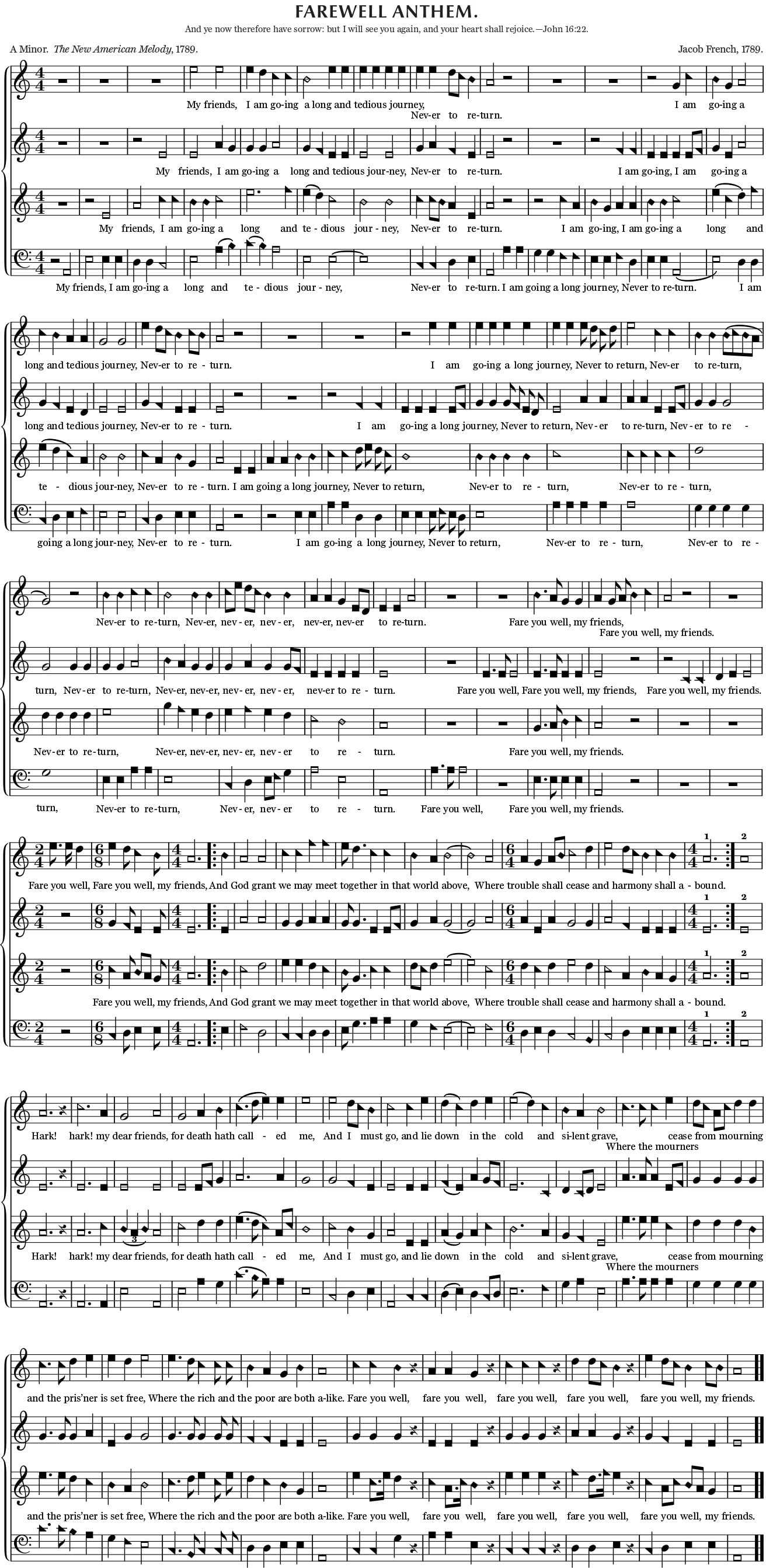
260 "Farewell Anthem," The Sacred Harp, 2025 revision, image from Sacred Harp Bremen.page number, title, meter, keytenor remains the reference linesystems stack the four partsanthem text moves through the pagebars and repeats control the routeSpeaker noteThis is the place to explain that Bremen presents the song as one long image, while the physical book spreads it across pages.
11
How texts work
What The Words Do
The poetry often names mortality, grief, judgment, consolation, pilgrimage, and glory without sanding off the edges. Part of the force of Sacred Harp is the way ordinary singers give those texts their full weight together.
12
How texts work
Examples Of The Words
Death, like an overflowing stream.
The Sacred Harp 1991, p. 50t, "Mortality"; also SH 181 "Exit," Shenandoah 119t/210, Kentucky 79, Sacred Harp Tunes "Halsey"
And am I born to die, to lay this body down?
SH 1991/2025 + Cooper 2012, p. 47b, "Idumea"; also SH/Cooper 428, SH 2025 213b, CH 55b/281t, Shenandoah 22b, Southern Harmony 31/281
I can but perish if I go.
SH 1991/2025 + Cooper 2012, p. 29t, "Fairfield"; also SH 94 / Cooper 294 "Never Part," CH 147/150, Southern Harmony 4b/48b/84
Farewell, vain world, I’m going home.
The Sacred Harp 1991, p. 282, "I’m Going Home"; also SH/Cooper 176t and 274t, plus SH 278b
13
Why this gets interesting
Why A Corpus Helps
Once the basics make sense, the research questions open up: which texts recur, which tunes carry the same words, how books revise inherited material, and how a living repertoire changes across editions while still feeling continuous to singers.